Max Ernst: The Restless Inventor of Dada and Surrealism
Max Ernst: The Restless Inventor of Dada and Surrealism
Max Ernst (1891–1976) was a German painter, sculptor, printmaker, graphic artist and poet, and a pioneer of both Dada and Surrealism in Europe. Few artists of the twentieth century changed how pictures get made as thoroughly as he did. He had no formal art training, yet he invented or developed techniques that let chance and the unconscious do part of the work.
Ernst’s life also tracks the upheavals of his century. He survived the trenches of the First World War, helped turn Cologne into a center of Dada, and joined the Surrealists in Paris. The Nazis condemned his art as degenerate, and he escaped occupied Europe for America in 1941. He returned to France in the 1950s and kept experimenting until his death, a day before his 85th birthday.
From Brühl to the trenches
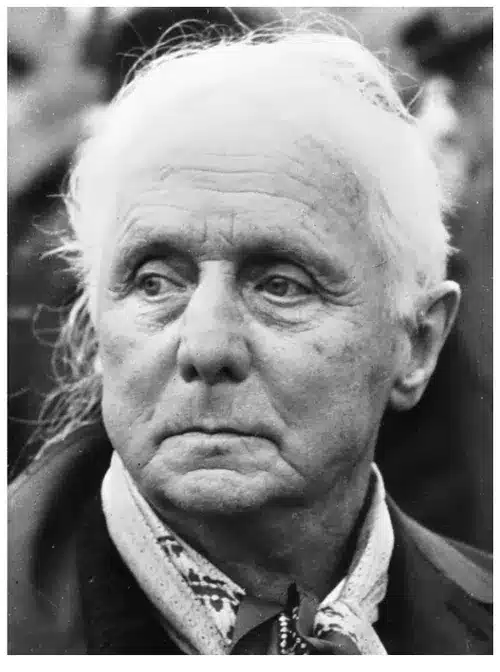
Ernst was born on April 2, 1891, in Brühl, south of Cologne, the third of nine children in a middle-class Catholic family. His father, Philipp, taught deaf children and painted as an amateur. He was also a strict disciplinarian, and the son’s lifelong defiance of authority began at home.
In 1909 Ernst enrolled at the University of Bonn to study philosophy, art history, literature, psychology and psychiatry. He never trained at an art school. He did visit asylums, where the art made by patients fascinated him, and this interest in the irrational would return throughout his work.
Painting soon overtook his studies. In 1911 he befriended August Macke and joined his circle of Rhineland Expressionists. The 1912 Sonderbund exhibition in Cologne then exposed him to Picasso, Van Gogh and Gauguin. In 1914 he met Hans Arp, beginning a friendship that lasted fifty years.
The First World War cut this short. Ernst was drafted and served on both the Western and Eastern Fronts for four years. Macke was killed in action, as was Franz Marc. Ernst later summed up the experience in his autobiographical notes: he had died on August 1, 1914, and been resurrected on November 11, 1918.
Dadamax in Cologne
Ernst came back from the war determined to attack the culture that had produced it. He returned to Cologne in 1918 and married the art historian Luise Straus. Their son, Ulrich, born in 1920, later became the American painter Jimmy Ernst.
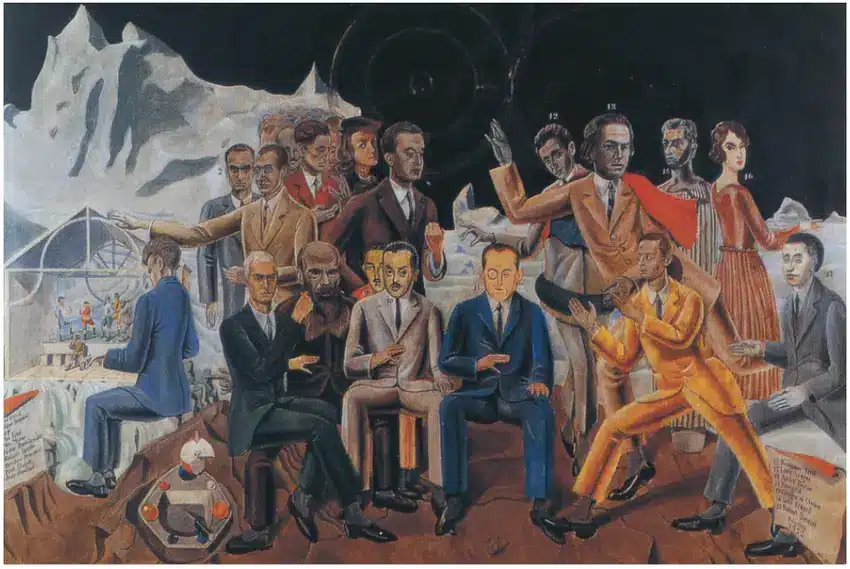
In 1919 Ernst founded the Cologne Dada group with the activist Johannes Theodor Baargeld and several colleagues, and Arp soon joined their activities. Ernst took the name Dadamax. The group published short-lived magazines such as Der Strom and Die Schammade, and staged provocations. The most notorious was a 1920 exhibition that visitors could only enter by walking through a public urinal.
The same period gave Ernst his first great medium. A 1919 visit to Paul Klee in Munich and an encounter with Giorgio de Chirico’s paintings opened new possibilities. Ernst began cutting up mail-order catalogs, teaching manuals and scientific illustrations, then reassembling them into impossible scenes. The result was collage as a form of hallucination, with the look of a dry textbook plate and the logic of a dream.
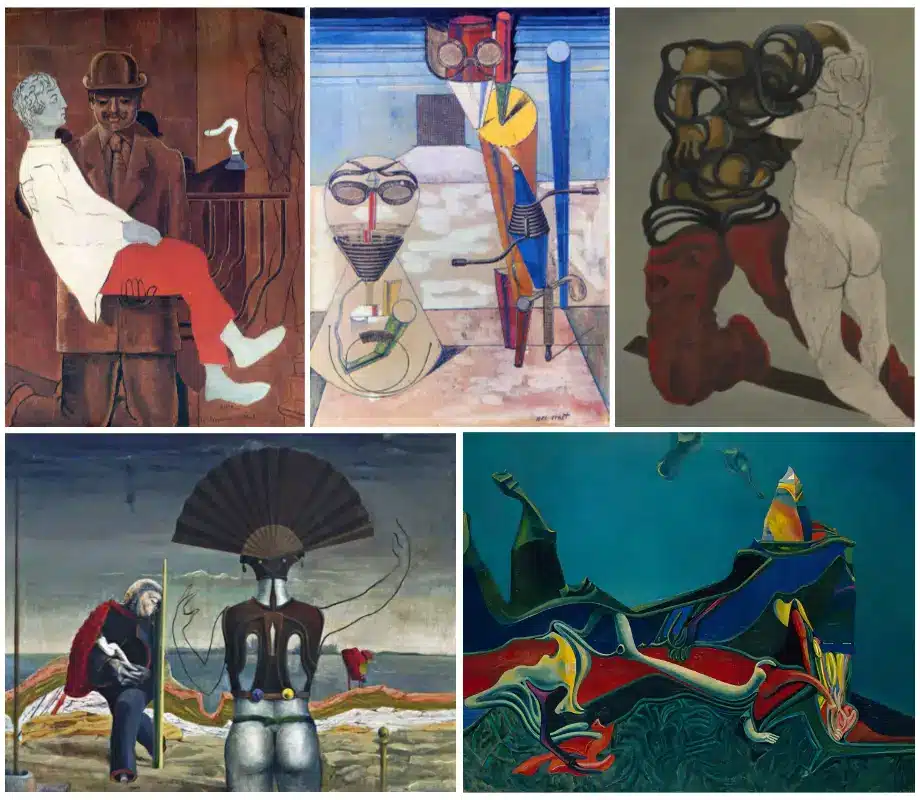
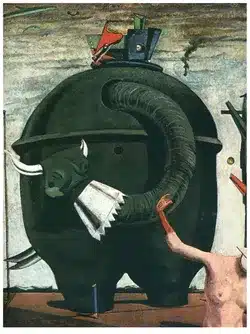
His paintings of the early 1920s carried the same logic onto canvas. The Elephant Celebes (1921) turns a boiler-like hulk into a menacing creature, and Ubu Imperator (1923) gives a tyrant the body of a spinning top. The poet Paul Éluard bought Celebes and became a lifelong friend after they met in 1921.
Paris and the invention of Surrealist technique
Ernst’s greatest contribution to Surrealism was a set of methods that made chance a working tool. André Breton had already shown his collages in Paris, at the gallery Au Sans Pareil in May 1921. In 1922, unable to get the proper papers, Ernst entered France illegally and moved in with Paul and Gala Éluard, leaving his wife and son behind. The three-way relationship ended after a trip to Saigon in 1924, the year Breton published the first Surrealist manifesto.
By then Ernst’s dream paintings had made him a natural member of the new movement. Two Children Are Threatened by a Nightingale (1924) combines paint with real wooden objects attached to the picture. In 1926 he caused a scandal with a painting of the Virgin spanking the infant Jesus, watched through a window by Breton, Éluard and Ernst himself.
In 1925, by his own account, Ernst stared at the worn floorboards of a seaside inn and began taking rubbings of them with paper and pencil. The grain suggested forests, creatures and landscapes he could never have planned. He called the method frottage, and published 34 of these images as the portfolio Histoire naturelle (1926).
Grattage carried the idea into oil paint. Ernst laid a painted canvas over a textured object, such as wire mesh or a comb, and scraped the paint away to reveal the pattern beneath. Forest and Dove (1927) shows the result: walls of petrified trees that seem to have grown by themselves. Forests, along with birds and strange suns, became one of the lasting images of his career.
Loplop, collage novels and sculpture.
Around 1930 Ernst’s work widened well beyond painting, and a bird became his alter ego. He named this figure Loplop and cast it as a presenter of other
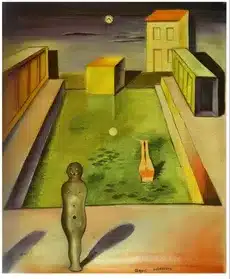
images, sometimes showing the work of fellow artists. Ernst traced his confusion of birds and humans to childhood. He said he woke one night to find his beloved pet bird dead, and moments later learned that his sister had been born.
He also created a new kind of book. La Femme 100 têtes (1929), Rêve d’une petite fille qui voulut entrer au Carmel (1930) and Une semaine de bonté (1934) tell wordless or nearly wordless stories through collage. Ernst cut up Victorian engravings so cleanly that the joins almost vanish. Respectable parlors fill with bird-headed men, floods and quiet violence.
He began making sculpture seriously in 1934, working alongside Alberto Giacometti. His pieces are playful and totemic, with figures built from casts of everyday objects. The King Playing with the Queen (1944) is among the best known.
Writing ran through all of this. Ernst wrote poems and theoretical texts, and his essay Beyond Painting set out how his techniques worked. He also made artists’ books that join word and image, including Maximiliana in the 1960s, with its invented script. He appeared on screen too, in Luis Buñuel’s 1930 film L’Âge d’Or.
War, internment and exile
The Second World War made Ernst an enemy to both sides. In 1937 the Nazis included his work in their Degenerate Art exhibition. That same year he began a relationship with the young English Surrealist Leonora Carrington, and they settled at Saint-Martin-d’Ardèche in southern France.
When war broke out in 1939, France interned him as an enemy alien at the Camp des Milles near Aix-en-Provence, alongside Hans Bellmer. Éluard and other friends won his release, but after the German occupation he was arrested again, this time by the Gestapo. He escaped to the United States in 1941 with the help of Varian Fry and the collector Peggy Guggenheim, whom he married at the end of that year. Luise Straus, his first wife, was not so fortunate: she was deported and died at Auschwitz in 1944.
Exile produced some of his most haunting work. Ernst adopted decalcomania, pressing wet paint between surfaces and pulling them apart, then developing the spongy textures into ruined landscapes. Europe After the Rain II (1940–42) reads as a vision of a continent destroyed. The Eye of Silence (1943–44) uses the same method.
He also experimented with oscillation, swinging a punctured paint can over a canvas laid flat. Among the European exiles in New York, Ernst helped shape the thinking of the younger painters who became the Abstract Expressionists, and this dripping method is often cited as a forerunner of Jackson Pollock’s.
Sedona, France and late recognition
Ernst finally found stability with the American painter Dorothea Tanning. They married in October 1946 in Beverly Hills, in a double ceremony with Man Ray and Juliet Browner. The couple then settled in Sedona, Arizona, a remote desert town of fewer than 400 people, where Ernst built a small house with his own hands.
The red-rock landscape seemed to echo the imaginary terrains he had been painting for years. In Sedona he compiled Beyond Painting and completed Capricorn (1948), a monumental sculpture of a seated royal couple. The couple’s presence helped start what later became an artists’ colony.
Ernst and Tanning moved back to France in the early 1950s. In 1954 he won the Grand Prize for painting at the Venice Biennale. Breton’s circle disapproved of such official honors, and Ernst was expelled from the Surrealist group.
The prize did him no harm. Major retrospectives followed, including at the Musée National d’Art Moderne in Paris (1959), the Museum of Modern Art in New York (1961) and the Tate Gallery in London (1962). He continued painting, sculpting and making prints into his eighties. Ernst died in Paris on April 1, 1976, and was interred at Père Lachaise Cemetery.
Legacy
Ernst’s lasting achievement is the idea that an artist can provoke images rather than simply compose them. Frottage, grattage and his collage novels gave later artists practical ways to let materials and accident lead. His refusal to settle into one style also set an example for artists who treat experiment itself as the work.
His art remains widely accessible. The Max Ernst Museum opened in his hometown of Brühl in 2005, spanning 70 years of his career, and the Menil Collection in Houston holds well over 100 of his works.