
Tintoretto, The Furious Painter of Venice
Tintoretto, The Furious Painter of Venice
Tintoretto, born Jacopo Robusti (1518/19–1594), was the boldest and most theatrical painter of sixteenth-century Venice. Alongside Titian and Veronese, he completes the trio of great masters of the Venetian late Renaissance. His contemporaries nicknamed him “Il Furioso” for the astonishing speed and energy of his brush.
He spent almost his whole life in Venice and devoted it to the city’s churches, confraternities and government halls.
His huge canvases use plunging perspective, flickering light and figures in violent motion to turn sacred stories into drama. His masterpiece, the decoration of the Scuola Grande di San Rocco, occupied him for more than twenty years.
The little dyer
Jacopo Robusti was born in Venice in late 1518 or in 1519; sources differ on the year. His father, Battista, was a cloth dyer, or tintore, which gave the son his nickname: Tintoretto, the “little dyer.” The family probably came from Brescia, in the Venetian mainland territories.
Little is known about his training. The early biographers Ridolfi and Boschini say his only apprenticeship was in Titian’s studio, and that Titian dismissed him after a few days. They disagree on why: Ridolfi blames jealousy of a gifted pupil, Boschini a clash of personalities. The story may be embroidered, but relations between the two painters did stay hostile, even though Tintoretto kept admiring Titian’s work.
He largely taught himself. According to Ridolfi he worked with furniture painters, drew from live models and studied anatomy. He collected casts and prints, including models of Michelangelo’s Dawn, Day, Dusk and Night, which he and his workshop drew from every angle. Ridolfi reports the motto he set over his studio: the drawing of Michelangelo and the color of Titian.
The Miracle of the Slave and a new style
Tintoretto made his name in 1548 with The Miracle of the Slave, painted for the Scuola Grande di San Marco. It shows Saint Mark plunging from the sky to save a Christian captive, as the instruments of torture shatter around him. The theatrical staging, unusual color and vigorous brushwork caused a sensation. His friend Pietro Aretino praised it, while warning him against painting too hastily.
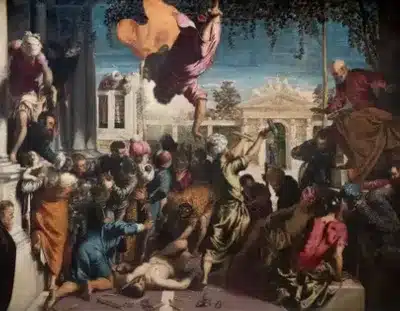
That tension followed him for the rest of his career. Speed was central to his method. He developed a fast technique known as prestezza, and critics found his loose brushwork either thrilling or careless. Sebastiano del Piombo reportedly said Tintoretto could paint in two days what took Sebastiano two years.
His pictures tell their stories through bodies in motion rather than through faces. Muscular figures twist through extreme foreshortening, and steep perspectives pull the viewer into the scene. He also thought about where people would stand. For the side walls of chapels, he composed with an off-center perspective so the depth would work when seen from an angle.
Early biographers say he worked out these compositions with small wax figures on a miniature stage, lit to test the fall of light. Whether or not every detail is accurate, the story fits the results, which often look like a darkened theater caught mid-scene.
Rivalry and ambition
Tintoretto competed for work by being faster, cheaper and more audacious than anyone else in Venice. Ridolfi wrote that he was always looking for ways to be known as the most daring painter in the world. Titian’s circle disparaged him, and in the 1550s the arrival of Paolo Veronese brought a new rival for the commissions he wanted.
His response was to go bigger. He offered his neighborhood church, the Madonna dell’Orto, two colossal canvases for little more than the cost of materials. The Worship of the Golden Calf and The Last Judgment (c. 1559–60) rise about 14.5 meters, and were intended to be the tallest canvases of the Renaissance. They earned him a reputation for finishing huge projects on small budgets.
He was equally inventive with subject matter. His Presentation of the Virgin (c. 1556), also at the Madonna dell’Orto, retells a subject Titian had painted, but replaces calm balance with figures on a dizzying staircase. Saint George, Saint Louis and the Princess (1553) has the princess astride the dragon, holding a whip, a witty reversal of the usual rescue.
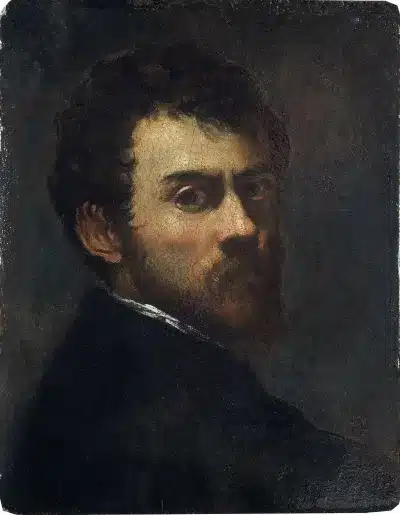
He was also Venice’s most prolific portraitist. His own two self-portraits show his range. One, from about 1546–47 (Philadelphia Museum of Art), is strikingly informal for its time, while the other, from about 1588 (Louvre), shows a stark, aged face.
The Scuola Grande di San Rocco
Tintoretto’s greatest achievement is the cycle of more than sixty canvases at the Scuola Grande di San Rocco, a wealthy Venetian confraternity. He worked there from 1564 to about 1588. The Scuola notes that some critics rank the pairing of painter and building as Venice’s answer to Michelangelo and the Sistine Chapel.
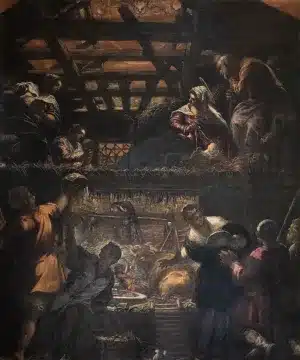
He won the job with his most notorious stunt. In 1564 the Scuola asked Salviati, Zuccari, Veronese and Tintoretto to submit designs for a ceiling painting of Saint Roch in Glory. While the others worked on their drawings, Tintoretto installed a finished painting on the ceiling. When the patrons objected, he replied that this was his way of drawing, and offered it as a gift. The Scuola accepted it on June 22.
He joined the confraternity and kept going. In November 1577 he offered to supply three paintings a year for the rest of his life in return for an annuity of 100 ducats. The deal gave him steady income and, just as importantly, a place to paint without competition.
The subjects were a deliberate break with tradition. Rather than illustrate the life of the patron saint, as Venetian confraternities usually did, Tintoretto built a connected program of biblical stories. The links between ceiling and walls make the upper hall read as one unified whole. He also turned the room’s difficult light and awkward doors to his advantage, and the result still feels like a single vision rather than a set of separate pictures.
Paradise, the Last Supper and the family workshop
Tintoretto’s late career made him the leading painter to the Venetian state. A fire in the Doge’s Palace in 1577 destroyed earlier works, including his own, and he joined Veronese in redecorating the building. He went on to paint mythologies, allegories and battle scenes there, among them the four celebrated canvases of the Sala dell’Anticollegio (c. 1578). Fast methods and a team of assistants let him produce more for the state than any competitor.
The crowning commission was Paradise, for the Great Council Hall. It measures about 9.1 by 22.6 meters and is reputed to be among the largest paintings ever made on canvas. Veronese and Francesco Bassano originally won the job, but Veronese died in 1588 before starting, and it passed to Tintoretto. His son Domenico and other assistants did much of the finishing. Venice applauded, though modern historians tend to prefer the two preparatory sketches, now in the Louvre and the Thyssen-Bornemisza Museum.
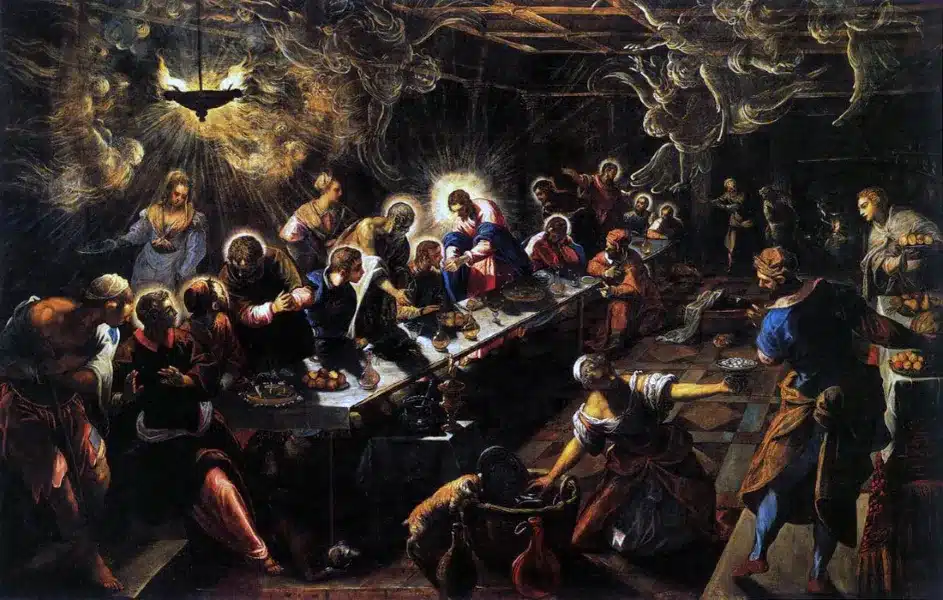
His final masterpiece may be The Last Supper (1592–94) at San Giorgio Maggiore, one of nine known versions of the subject. Leonardo’s famous treatment is calm and symmetrical. Tintoretto sets the table at a steep diagonal in a dark room and fills the air with glowing angels, in a way that seems to anticipate the Baroque.
The workshop was a family business. His daughter Marietta Robusti, born before his marriage to Faustina de Vescovi, trained with him and became a respected portraitist. As a girl she is said to have accompanied him to work dressed as a boy. His sons Domenico and Marco also trained as painters. Marietta’s death in 1590, at about thirty, was a heavy blow.
Tintoretto hardly ever left Venice. He died there on May 31, 1594, after two weeks of stomach pains and fever, and was buried in the Madonna dell’Orto beside Marietta.
Legacy
Tintoretto’s restless compositions and dramatic light pointed the way from the Renaissance toward the Baroque. El Greco, who likely saw his work during a stay in Venice, absorbed his influence. Centuries later John Ruskin championed him passionately in his writing on Venice, and Manet copied his late self-portrait.
His looseness, once criticized as haste, now looks strikingly modern. Interest in him remains strong: a major anniversary exhibition reached the National Gallery of Art in Washington in 2019, the first Tintoretto retrospective in the United States. To see him at full strength, though, you still have to go to Venice.
CanvasPaintArt
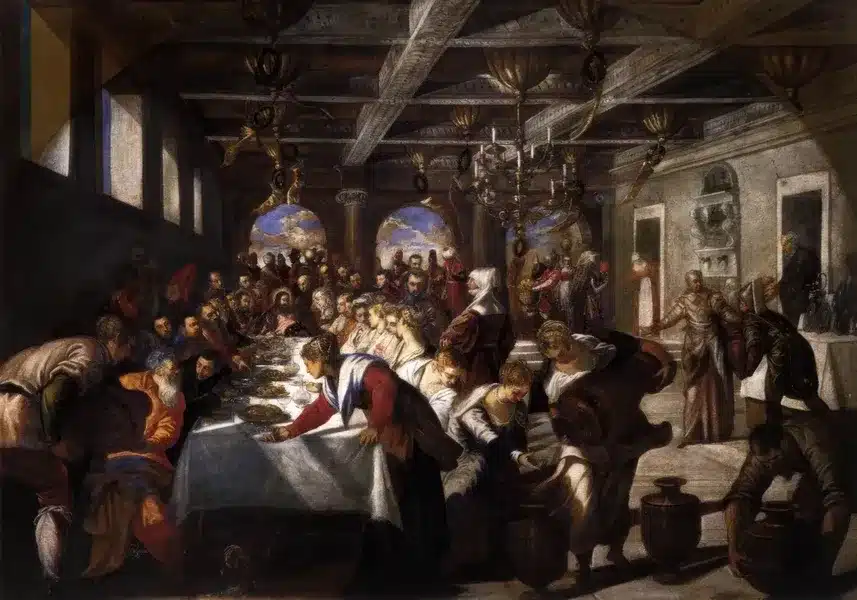
Some of Tintoretto’s Paintings